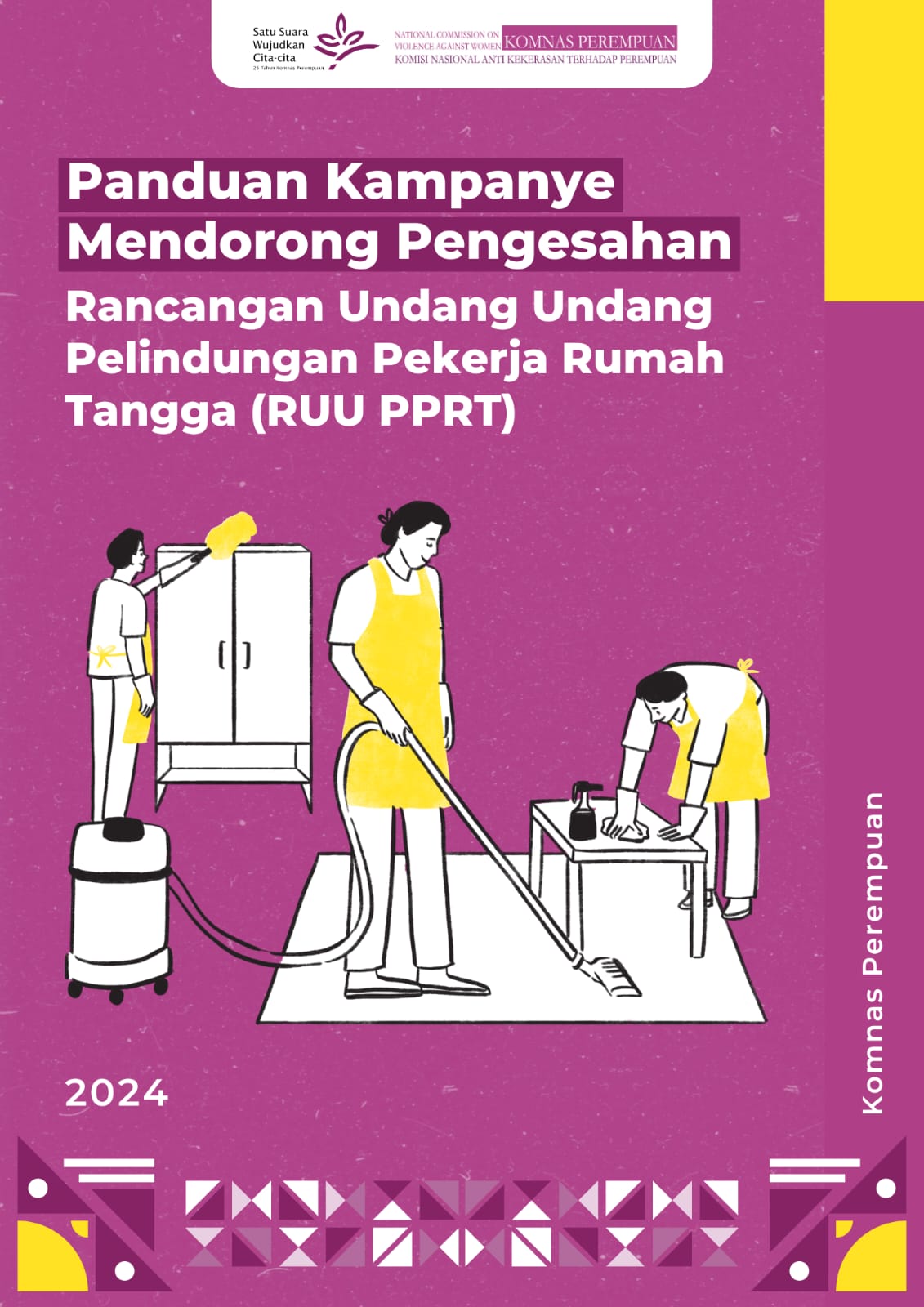
Guidelines for the Campaign to Advocate the Enactment of the Domestic Workers Protection Bill
Domestic Workers (PRT) are individuals employed with specific responsibilities to manage the household and family members within it. This work falls under the category of care work, which is also one of the oldest forms of labor. The existence of domestic workers is rooted in the global history of slavery and the slave trade in the 19th century, colonialism, and other forms of forced labor. The role of domestic workers in sustaining public life cannot be overlooked. Domestic workers are the invisible powers that enable the functioning of the economy, governance, services, and other public sectors. They underpin public work through the domestic institution—the family—by managing the household while homeowners, both men and women, engage in work in the public sphere.
The National Advocacy Network for Decent Work for Domestic Workers (JALA PRT) conducted a rapid assessment in 2009 on the number of domestic workers in Indonesia. The results indicated that the estimated number of domestic workers in Indonesia reached 10,744,887, with 67% of middle- and upper-class households employing domestic workers. Of that figure, around 30% were child domestic workers (PRTA). This rapid assessment confirmed ILO data which stated that the majority of domestic workers are women—approximately 92%. JALA PRT’s research further revealed, based on compiled data, that the age distribution of domestic workers is: 22% under 18 years old, 57% aged 18–50 years, and 21% over 50 years old. In terms of educational background, 27% had completed only primary school, 68% junior high school, and 5% senior high school. Most came from rural areas and urban poor communities.
Although domestic workers in Indonesia and migrant domestic workers represent a significant labor force and an alternative form of employment for women, domestic work has not yet been formally recognized and protected by law. As a result, domestic workers remain highly vulnerable to violence and abuse. According to JALA PRT, from 2018 to 2023 there were 2,641 recorded cases of violence against domestic workers. The majority involved psychological, physical, and economic violence in the workplace. Some domestic workers experienced unpaid wages (ranging from 2 to 11 months’ salary), dismissal, or wage cuts by employers when they fell ill and were unable to work. In fact, domestic workers clearly fulfill the elements of an employment relationship, namely the existence of instruction, work, and remuneration, as stipulated in Article 1 of Law No. 13 of 2003 on Manpower.
The year 2024 marks a critical point for advocacy on the Draft Law on the Protection of Domestic Workers (RUU PPRT), especially as the 2024–2029 term of the House of Representatives (DPR RI) will soon commence, while the bill has yet to be deliberated and passed at the Level I discussion in DPR RI. With limited time remaining, Komnas Perempuan, together with civil society networks, has consolidated efforts to develop joint strategies and actions to continue the advocacy for the RUU PPRT, particularly through the formulation of public campaigns this year. Komnas Perempuan hopes this guide will serve as a public reference in designing campaigns to push for the enactment of the RUU PPRT until it is passed by DPR RI.
